Your push-button start beeps and the dashboard says 'key not detected.' Yes, you can still drive home. Here's the fallback procedure for every major make sold in PSL.
Every push-to-start vehicle sold in the US has a backup procedure for dead key fob batteries - you can almost always start the car by pressing the fob directly against a specific spot on the steering column, dashboard, or center console, then pressing the brake and the start button.
The exact spot varies by make - we cover Toyota, Honda, Ford, Nissan, Hyundai, Chevy, Mazda, Volkswagen, BMW, and Mercedes below. The procedure works because the fob has a passive RFID chip in addition to the battery-powered remote, and the car has an RFID antenna at a specific location.
If the backup procedure doesn't work, the fob's RFID chip may be damaged or the car's antenna failed. Doctor Lockout cuts replacement keys and programs new fobs on-site for most vehicles across Port St. Lucie. Call (772) 284-5142.
Modern push-to-start cars have two ways to communicate with your fob:
When the fob battery dies, the active signal stops, but the passive RFID still works. You just have to put the fob close enough to the car's antenna for the RFID to be detected. Every manufacturer designs this in - they call it various names: "emergency start," "passive start backup," "limp-home mode."
Most 2010+ Toyota and Lexus models use the same fallback procedure:
If that doesn't work, the antenna may be in the center console (some Camry, Avalon, Sienna years) - try touching the fob to the console cup holder area instead.
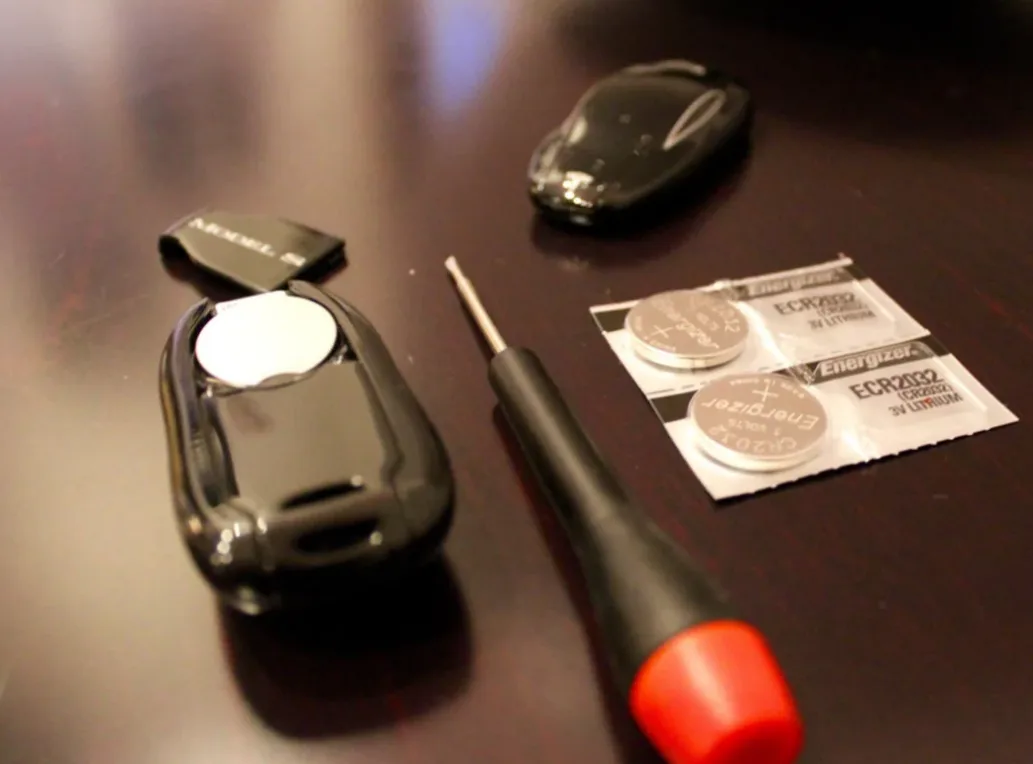
After you get home, replace the fob battery (CR2032 for most Toyotas, CR1632 for some Prius and Lexus). About $4 at any drugstore, slot-headed screwdriver to open the fob.
| Vehicle / Fob Type | Backup Method If Fob Dies | DIY Battery Swap? | Locksmith Call Cost |
|---|---|---|---|
| Tesla Model 3 / Y | Use the key card on the B-pillar | N/A - card not battery | If card lost, $280-$500 |
| Toyota Camry / RAV4 (2014-2024) | Hold fob against push-button | Yes - CR2032 | $30-$80 lookup |
| Ford F-150 (smart key) | Hold fob next to start button | Yes - CR2450 | $40-$95 |
| Honda Civic / Accord (2013+) | Hold fob in cup-holder | Yes - CR2032 | $30-$80 |
| GM (Chevy, GMC, Buick) | Hold fob to start switch | Yes - CR2032 | $30-$80 |
| Older transponder key (no buttons) | No backup - need new key | N/A | $160-$280 cut + program |
2014+ Honda and Acura with proximity entry:
Some older Acura RDX and TLX models have the antenna at the steering column - touch the fob to the column just behind the start button if the START/STOP touch doesn't work.
Honda Civics, Accords, CR-Vs, and Pilots from 2016+ all follow the same procedure. CR-V Hybrid and Insight have the antenna slightly higher on the dash - touch the fob to the column shroud right under the dash.
Real locksmith, real ETA, honest price quoted before any tools come out. 15-30 minute arrival across the Treasure Coast.
Call (772) 284-5142Most Ford push-button models (Edge, Escape, Explorer, F-150, Fusion, Lincoln MKX/MKC/Aviator):
If you have a Ford with the older "Intelligent Access" system (2013-2017 models), the backup spot may be inside the steering column to the right of the start button - press the fob there if direct contact with the button doesn't work.
2010+ Nissan Altima, Maxima, Murano, Pathfinder, Rogue, Sentra, and most Infiniti models:
If you have a Nissan with intelligent key dashboard light flashing rapidly, the procedure is the same - the light just indicates low fob battery, not a different start procedure.
Most 2014+ Hyundai (Elantra, Sonata, Santa Fe, Tucson, Palisade) and Kia (Optima, Sorento, Telluride, Forte):
For Genesis models, the antenna is typically in the steering column. Touch the fob to the column just below the start button.
GM uses a slightly different approach. On 2015+ Silverado, Sierra, Tahoe, Yukon, Suburban, Escalade, Cruze, Malibu, Equinox, Terrain, Acadia, Enclave:
Cadillac CT5, CT6, XT5, XT6, Escalade - same procedure, but the cup holder antenna placement is more common.
Mazda (2014+ Mazda3, Mazda6, CX-5, CX-9): hold fob against the START button, press brake, press start. Some CX-5 and CX-9 models have a cubby below the steering column for the fob.
Volkswagen and Audi: on Tiguan, Atlas, Jetta, Passat, Audi Q5, Q7, A4, A6 with KESSY (proximity entry), insert the fob into the cubby in the center console between the seats (look for a small fob-shaped opening). Press brake, press START.
BMW (most models 2010+): the fob slot is built into the dashboard, usually to the right of the steering column. Insert the fob into the slot, press brake, press the START/STOP button. For models without a physical slot, hold the fob against the START button.
Mercedes-Benz (most models 2013+): the start button has an embedded antenna. Hold the fob directly on the button, press brake, then press the button.
If you've followed the procedure for your make and the car still says "key not detected," one of three things is happening:
For options 1 and 2, call Doctor Lockout. We come to you with mobile fob programming equipment for most makes and models - no tow needed. See our key fob programming and car key replacement pages.
On-site programming and key cutting from Doctor Lockout:
Most non-luxury vehicles finish on-site in 30-60 minutes. Luxury and European vehicles may need a 24-hour parts window. We're significantly cheaper than dealer pricing for the same work.
2-4 years for most CR2032-based fobs with average daily use. Heavy use (multiple unlock/lock cycles per day) cuts this to 1-2 years. PSL heat doesn't significantly affect fob batteries since they're inside the cabin most of the time.
Sometimes. Some Toyota, Honda, and Ford models support owner programming through a dashboard sequence (press brake X times, insert backup key, etc.). Most don't, and require a J2534 programming tool. Online "OEM" fobs are also often counterfeit and may not pair to your VIN even with the right tool. We charge less than the dealer and the work is guaranteed.
Most do, but not all. Toyota, Honda, Ford, Nissan, GM, Hyundai/Kia push-button keys have a slide-out emergency blade for unlocking the driver's door if the fob is fully dead. The blade slot is usually on the back or side of the fob. Some pure-electronic vehicles like newer Teslas have no physical key blade at all.
This is the textbook lockout scenario. Use the slide-out emergency key (if your fob has one) to unlock the driver's door manually. If your fob doesn't have a hidden blade, or if the door cylinder has been disabled (some newer cars), call us for a car lockout - 15-30 minute response across PSL, non-destructive entry. See car lockout service.
No. The battery only powers the radio signal; the programming is stored in non-volatile memory on the chip. Battery swaps don't affect programming. The 30 seconds your fob is without power doesn't matter.
Yes. If the car's main 12V battery is fully dead, the antenna that energizes the fob's RFID may not have power. Jump-start the car first, then the fob procedure will work normally. This is the most common "the fob procedure doesn't work" diagnosis we run - it wasn't the fob, it was the car battery.
Doctor Lockout runs 24/7 across the Treasure Coast. Real person on the phone in under 2 rings, locksmith on-site in 15-30 minutes, honest quote before any work starts.
Call (772) 284-5142Doctor Lockout serves Port St. Lucie and the entire Treasure Coast 24 hours a day, including these neighborhoods and surrounding cities:
Last updated: 2026-05-18