Your panic bar pushes in, but the door doesn't grab the strike. Here's the field-tested diagnostic any store manager can run before calling for service.
Panic bars that won't latch usually fail in one of four places: a worn latchbolt or strike, a dogged-down internal mechanism, a dead-locked outside trim, or a sagged door that's missing the strike by 1/4 inch. 80% of these are solved without replacement parts.
Quickest test: press the bar in and watch the latchbolt at the top or side of the door. If it retracts cleanly and snaps back, the bar itself is fine and the problem is the strike or door alignment. If it stays retracted or moves sluggishly, the bar mechanism is the issue.
Doctor Lockout services Von Duprin 99, Sargent 80, Detex Advantex, and Yale 7000 panic hardware across Port St. Lucie, Stuart, Fort Pierce, and the Treasure Coast. Call (772) 284-5142 for same-day repair or replacement, with quotes given in writing before work starts.
Before you blame the panic bar, rule out the door closer. A door that doesn't close won't latch either, and the symptoms look identical from a distance.
Stand inside the door, push the bar to retract the latch, and then watch the door close on its own. If the door:
Only after you've confirmed the door is actually reaching the frame should you dig into the panic bar itself.
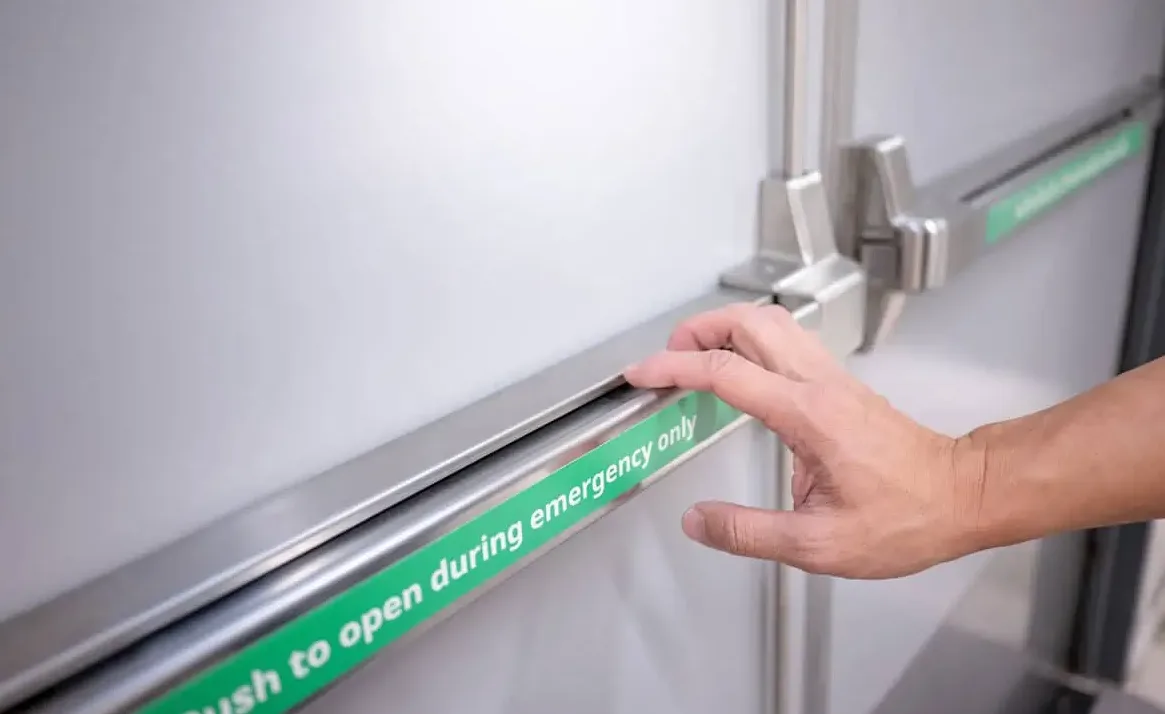
"Dogging" is a panic-hardware feature that lets you hold the latch retracted - useful during business hours so customers can pull the door open without pushing the bar. The mechanism is usually a small hex socket or key cylinder on the bar itself.
If someone dogged the bar at closing time and forgot to undog it, the latch is stuck in the retracted position. The door pushes shut, but there's nothing for the strike to catch.
Undogging by model:
This is the single most common "broken" panic bar call we run. About one in four turns out to be an accidentally dogged bar. Costs you nothing to check first.
| Panic Bar Brand | Common PSL Use | Typical Lifespan | Rebuild vs Replace Threshold |
|---|---|---|---|
| Detex Value Series V40 | Most retail / storefront | 8-15 years | Replace if mechanism is sloppy |
| Von Duprin 99 Series | Office, school, hospital | 15-25 years | Rebuild kit available; usually cheaper |
| Adams Rite 8000 Series | Aluminum storefront | 10-20 years | Replace if face plate damaged |
| Sargent 80 Series | Heavy commercial | 20-30 years | Almost always rebuild |
Panic bar latches are the highest-cycle hardware in any commercial building - a school exit can hit 50,000+ cycles per year. The latchbolt face wears smooth, and the strike box edges round off until the bolt skips out of engagement.
How to inspect:
If the latchbolt is rounded or the strike is worn, the bolt is literally cam-ing back out under spring pressure when the door closes. Replacement latchbolt assemblies for Von Duprin 99 are about $85-$140 retail; strike plates run $25-$55. We carry both on the truck for same-day fix.
Real locksmith, real ETA, honest price quoted before any tools come out. 15-30 minute arrival across the Treasure Coast.
Call (772) 284-5142Panic bars usually pair with an outside trim - either a lever, knob, or pull handle - that lets people enter the door when it's unlocked from the outside. The trim has its own lock cylinder, and when that cylinder is in the "locked" position, it often dead-locks the inside bar mechanism too.
This is by design on Storeroom function (Function 09) and Classroom function (Function 13) trims. If the outside cylinder is locked, the inside bar can still push out (life safety code requires it), but the bar may feel sticky or the latch may not fully throw back into position.
Quick check: pop the outside key in, turn to the unlocked position, then try the bar. If the bar suddenly feels normal and the latch operates properly, you had a trim-state issue, not a hardware failure.
Heavy commercial doors sag over time, especially metal frames in the older retail buildings around US-1 and east Fort Pierce. When the door drops 1/4 inch on the latch side, the panic bar's latchbolt no longer aligns with the strike box.
Drop a Sharpie mark across the latchbolt onto the strike plate, close the door, then open it. If the fresh ink is below the strike box opening, the door has sagged.
Fixes:
See our commercial door hinge service for sag and replacement options.
Honest 2026 pricing across our Treasure Coast service area:
We quote on-site before any work, and we tell you when adjustment will solve it vs when replacement is the only honest answer. See our crash bar repair service page.
DIY-safe if:
Call Doctor Lockout if:
Two things kill panic bars faster in PSL than in cooler climates:
Salt air corrosion on coastal storefronts (Hutchinson Island, Jensen Beach, Stuart waterfront, Sandpiper Bay). The chrome or brass finish bubbles, then the internal springs and pivot pins corrode. Stainless steel models like Von Duprin 99-EO-F (fire-rated, stainless) last 2-3x longer here.
The 9-day rainy-season humidity spikes cause aluminum panic bar frames to swell against the steel internals, binding the touch bar. If the bar feels stiff only during rainy weeks, it's almost certainly a humidity-and-corrosion issue inside the chassis, not a broken spring.
Building inspectors in St. Lucie County and Martin County will fail a panic device that doesn't latch reliably, doesn't release the latch with a single motion, or requires more than 15 lb of pressure to operate. If you're due for a fire inspection, get it fixed first.
You have an alarmed exit device, probably a Detex ECL-230 or similar. The alarm fires whenever the bar is pushed, by design, to deter unauthorized exits. To silence: insert the alarm key and turn to disarm, or have it re-keyed if you've lost the key. We see this constantly on after-hours service calls.
You can in unrated applications. You cannot in fire-rated openings - the replacement must carry the same UL fire rating as the door assembly. Generic panic bars from box stores typically aren't fire-rated, which means a fire-rated door becomes legally non-compliant the moment you swap the bar. For PSL retail, schools, and restaurants, stick with rated hardware.
NFPA 80 and Florida fire code require annual inspection of fire-rated panic hardware. ADA-rated buildings should test all exit hardware monthly. In practice, most PSL retail buildings get inspected when the fire marshal walks through, which is once a year on average. We offer commercial maintenance plans that include quarterly checks for franchises and chains.
A panic bar is rated for life safety (allows fast egress under panic conditions). A fire exit bar is rated for both panic AND fire containment - it has to keep working after exposure to fire, no dogging allowed, and uses different latching internals. Look for the UL label on the inside of the bar cover; fire-rated bars are clearly marked.
Yes for Von Duprin 99, Sargent 80, Detex Advantex, Detex ECL-230, and Yale 7000. We carry full bar replacements plus the common parts: latchbolts, strikes, end caps, dogging mechanisms, and trim cylinders. For exotic models (Adams Rite, Precision, older Falcon) we usually have to order, but those repairs still finish within 24-48 hours.
15-30 minutes during weekday business hours for PSL, St. Lucie West, Tradition, and the Treasure Coast retail corridor along US-1. After hours and weekends we add 10-15 minutes. For fire-marshal-related emergencies we move you to the front of the queue.
Doctor Lockout runs 24/7 across the Treasure Coast. Real person on the phone in under 2 rings, locksmith on-site in 15-30 minutes, honest quote before any work starts.
Call (772) 284-5142Doctor Lockout serves Port St. Lucie and the entire Treasure Coast 24 hours a day, including these neighborhoods and surrounding cities:
Last updated: 2026-05-18